


Cuba
Republic of Cuba | |
|---|---|
.svg) Coat of arms
| |
| Motto: ¡Hasta la Victoria Siempre! (Onwards to Victory, Always) | |
| Anthem: Himno Nacional de la República ("National Anthem of the Republic")[1] | |
| Regional flag Antillean banner  | |
 The 6 main provinces of which Cuba is divides into. Ciudad de La Habana is highlighted as blue. | |
.svg) Cuba highlighted on the Globe | |
| Capital | Ciudad de La Habana |
| Recognised regional languages |
|
| Ethnic groups |
|
| Religion (2020) |
|
| Demonym(s) | Cubans |
| Membership | Caribbean Community |
| Government | One party unitary republic system |
| Miguel Díaz-Canel | |
| Manuel Marrero | |
| Álvaro López Miera | |
| Legislature | National Assembly of People's Power |
| Independence | |
| 10 February 1878 | |
• Baraguá Manifest | 15 March 1878 |
• Jimaguayú Constitution | 30 October 1897 |
| 26 July 1953 | |
| Area | |
• Total | 114,524 km2 (44,218 sq mi) (96th) |
• Water (%) | 0.94% |
| Population | |
• 2024 estimate |  11,033,993 hab 11,033,993 hab |
• 2012 census | 9,723,605 hab |
• Density | 101.72/km2 (263.5/sq mi) (66th) |
| GDP (PPP) | 2023 estimate |
• Total | $633.400 billion |
| HDI (2020) | 0.781 high |
| Currency | Cuban peso (CUP) |
| Time zone | UTC-5 |
• Summer (DST) | UTC-4 |
| Date format | (DD/MM/YYYY) |
| Driving side | right side |
| Calling code | +53 |
| Internet TLD | .cu |
.jpg)
Cuba is an island country in the Caribbean Sea. The country is made up of the big island of Cuba, the Isla de la Juventud island (Isle of Youth), and many smaller islands. Havana is the capital city of Cuba. It is the largest city. The second largest city is Santiago de Cuba. In Spanish, the capital is called "La Habana". Cuba is near the United States, Mexico, Haiti, Jamaica and the Bahamas. People from Cuba are called Cubans (cubanos in Spanish). The official language is Spanish. It is the largest island of the West Indies and the second most populous island (after Hispaniola) of the West Indies. Cuba is warm all year.
In 1492, Christopher Columbus landed on the island of Cuba. He claimed it for the Kingdom of Spain. Cuba became a Spanish colony until the Spanish–American War of 1898. In 1812 Jose Aponte led the First Cuban rebellion against the Spanish monarchy. After the Spanish-American war, it was a protectorate of the United States. It gained independence in 1902.
In 1959, guerrilla fighters led by Fidel Castro and Che Guevara overthrew Cuba's dictator, Fulgencio Batista, in what became the Cuban Revolution. The United States had supported Castro in 1958 by stopping the sale of weapons to the Batista government,[2] At first, relations were friendly between Castro and the United States government under President Dwight D. Eisenhower. However, Castro began making relations with the Soviet Union. Castro tried to take over American businesses and land owned by Americans without paying the owners; the United States did not like this. In 1961 Castro officially announced that his government was communist. The new United States President, John F. Kennedy, ordered an attack to invade Cuba. The plan was to take control of the country and overthrow its communist government. The attack failed. The Communist Party of Cuba was created in 1965 and has ruled the island ever since. Today, Cuba is the only communist state outside of Asia, in the Caribbean, and in the western hemisphere.
Culture[change | change source]
Cuba is famous for many types of music, especially dance music such as the Salsa and Mambo. Because Cubans have ancestors from Spain, Africa, South America and North America, Cuban music is special and different.
Reading is very popular in Cuba. Many people especially enjoy reading books or things that come from outside the country, even though the government does not approve of this. They also love music and sports. Cuban music is very lively. This is because a lot of it comes from African and Spanish rhythms. Baseball, basketball, and athletics events are loved by many Cuban people. The Chiefs football-team took at one Football-World-Cup part. In 1938, they reached the quarter-final and lost against Sweden 0:8.[3]
History[change | change source]
-
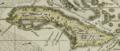 A map of Cuba made in 1680
 -
 Black Cubans in Havana during the 1800s
 -
 Workers on a Cuban sugar plantation
 -
 Cuban revolutionaries in 1958


.jpg)

Early history[change | change source]
Before Cuba was conquered by the Spaniards, three tribes lived on the island. They were the Taínos, the Ciboneys, and the Guanajatabeyes. The Taínos were the largest and most common of the three tribes. They farmed crops such as beans, corn, squash, and yams. The Taínos also slept in hammocks, which the Spaniards would introduce to the rest of the world. Then, in 1492, Christopher Columbus arrived in Cuba on his first trip to the Americas. Three years later, he claimed the islands for the Spanish. The Spanish began to rule Cuba afterwards. The Spanish brought thousands of slaves from Africa to Cuba to work for them. Most of the native Cubans died because of the new diseases brought by the Spanish and Africans. The Spanish also treated the native Cubans very cruelly and killed many of them.
The Spanish ruled for many years. Cuba became the most important producer of sugar. In the early 1800s, Cubans rebelled against the Spanish rulers, but failed until 1898, when the United States went to war with the Spanish and defeated them. This was the Spanish–American War. Cuba became American for four years afterwards, before it became an independent republic in 1902. Even though Cuba was independent, the Americans still controlled the island by a law called the Platt Amendment. In 1933 the Cubans stopped the Platt Amendment, but the Americans still had a big say in Cuban politics. Americans owned most of Cuba’s businesses. The Americans supported the leader Fulgencio Batista, who was seen by many Cubans as corrupt.
As well as controlling Cuban politics, the United States also had a lot of control over the Cuban economy. At the time, Cuba was a monoculture economy. They produced coffee, tobacco, and rice, but mostly they produced sugar. So Cuba was known by other countries as the "sugar bowl of the world."[4] The United States bought sugar from the Republic of Cuba at a price higher than everyone else in the world so that Cuba favoured the United States and its industries. Cuba depended on the United States and their investments. Cuba was not industrialized and needed the money for goods and oil. Cuba also needed US money for gas, electricity, communications, railways, and banks. Although Cuban workers had better conditions than other countries in Latin America, they still faced inequality, lack of infrastructure, high illiteracy rates, and a lack of full-time work (the sugar industry was not the same all year round).
Cuban Revolution[change | change source]
In 1959, Fidel Castro led a revolution against Fulgencio Batista. Castro took power in Cuba with Che Guevara from Argentina, his brother Raul, and others who fought against Batista. Castro made many changes to Cuba. He ended American ownership of Cuban businesses. This made Castro unpopular in America and the United States banned all contact with Cuba. Many Cubans went to America because of this. In 1961, the Americans helped some of these Cubans to attack Cuba and try to remove Castro, but they failed. Castro then asked the Soviet Union to help defend them from the Americans, which they did. The Soviet Union put nuclear weapons in Cuba and aimed them at the United States. American President Kennedy demanded that they be removed or a new war would begin. This was known as the Cuban Missile Crisis. The Soviet Union removed the missiles when the United States agreed to not continue attacking Cuba and to remove missiles from Turkey.
Cuba became a communist-led country like the Soviet Union after this. The Soviet Union bought most of Cuba’s sugar at high prices. Cuba spent this money on health, education and the army. This made Cuba’s schools and hospitals some of the best in the world. The army fought in Africa to support black Africans against the white South African army. Cuba also supported groups in South America fighting against the dictators of those countries.
However, the Cuban government began to control most of life in Cuba under the communist system. Disagreeing with the Cuban government and Fidel Castro in public was not allowed. Some Cubans did not like this and tried to leave Cuba. Most Cubans who left went to the United States. Some Cubans who did not like the government and stayed were put in jail. Many groups from around the world protested against Cuba because of this, and demanded that Fidel Castro give up power.
In 1991, the Soviet Union collapsed. This meant that Cuba, which had sold most of its products to the Soviet Union, had no money coming into the country. The Americans made the restrictions against contact with Cuba tighter. America said the restrictions on contact would continue unless Fidel Castro gave up power. Cuba became very poor in the 1990s. This became known in Cuba as “The Special Period”. Because of the disaster, Cuba changed to allow less control by the government, more discussion amongst the people, and private shops and businesses. Cuba also tried to get tourists to visit the island.
In the 2000s, tourism to Cuba began to make money for the island again. Though Fidel Castro had remained in power, he had passed all duties to his brother Raul after an illness. Fidel Castro was one of the longest-serving heads of state. In 2018, Miguel Díaz-Canel became the official President of Cuba.
In April 2015, historic talks took place with US President Obama and Cuban General Secretary Raúl Castro about improving relations between the two nations.
The trade embargo issued by President Kennedy in the 1960s was considerably loosened under Obama's administration. US citizens can now travel directly to Cuba at certain times of the year. Before, Americans had to go via Mexico if they wanted to go to Cuba. Americans are still not allowed to purchase or smoke Cuban cigars. The cigars are smuggled over the US-Canadian border since they are legal in Canada.
For military service, men from the age of 17 to 28 years old must go into the army for two years.[5] It is optional for women.
In July 2021, there were demonstrations against the government. See the English Wikipedia article, 2021 Cuban protests, for details.
Administrative divisions[change | change source]
The country is divided into 15 provinces and one special municipality (Isla de la Juventud). The provinces are divided into municipalities.

Demographics[change | change source]
The population of Cuba is close to 13 million. The people of Cuba come from three different groups. The largest group is the descendants of the Spanish settlers who came to Cuba. The smallest group is the descendants of the black African slaves who were brought in to do the work and birth children (in the barracoon) as New World slaves who could be legally sold into life time bondage in the United States. The middle-sized group is a mix of African and Spanish. The government succeeded in seeing that the three different groups were treated the same. According to a DNA Caribbean Studies Institute, the racial-makeup of the population of Cuba is:
- European Cubans descend from settlers that came during the very late 15th century and onward. Most white Cubans came from many different parts of Spain, but most came from the Canary Islanders, Andalusians, and Catalans. There was as well some French, Italian and English people. Whites make up approximately 30% of Cuba's population as of 2012, and they mostly populate the western part of Cuba, specially cities like Havana and Pinar del Rio. These people brought with them their language, religions, music and others.
- Africans and Mulatto Cubans descend from the arrival of African slaves that came from various parts of Africa but the most numerous were West Africans. There were also more than 500,000 Haitians that came to Cuba during the Haitian Revolution days. Most Cuban slaves tended to come from the Kongo and Yoruba tribes, there were also the Igbos, Ewes, Fons, Fulas, Mandinkas and some others. Afro-Cubans range enormously from 33.9 percent to 70 percent of the population, and they are mostly concentrated in the east parts of Cuba. These brought with them their instruments, religion (Santeria), and customs to the Cuban culture.
- Mediterranean Cubans are about 3% of the population; however, one must know that a lot of the southern Spaniard Cuban descendants have a good portion of Moor blood in their family lines. This is due to the close proximaty of Spain to North Africa. Many Mediterranean Cubans came during the 1820s-1880s and sometimes onward. These are mostly concentrated in the east, especially in cities such as Guantanamo Bay. They brought much of their foods and cuisines to Cuba and a few words.
Christianity is the most widespread religion in Cuba, with Catholicism being its largest denomination, which is practiced by more than 53% of the Cuban population. Protestantism is practiced by less than 3% of the Cuban population. A large part of the Cuban population is either non-religious or practices folk religions such as Santeria. Hinduism is practiced by 0.2% of the population and Islam is practiced by less than 0.1% of the population.
Health and education[change | change source]
Cuba is a developing country, and, by economic measures, is a very poor country. In some aspects however, like education, health care and life expectancy it ranks much better than most countries in Latin America.[6] Its infant death rate is lower than some developed countries.[7] The average life expectancy is 78 years,[5] about the same as in the United States.
All the children are required to go to school from six to twelve years old, and nearly everybody is able to read and write at least. There is free education at every level. Because of this,[8] Cuba has a 99.8% literacy rate.[9]
In 2006, the World Food Programme certified Cuba to be the only country in this region without undernourished children. In the same year, the United Nations said that Cuba was the only nation in the world that met the World Wide Fund for Nature's definition of sustainable development.[10]
Geography[change | change source]

Cuba is the largest island in the West Indies. It has many resources. Only about one-fourth of the land is mountains or hills. Much of the land is gentle hills or plains which are good for farming or raising cattle. Cuba has fertile soil and a mostly warm and humid climate that makes it a great place for growing crops.
Sugar is the most important crop of Cuba, which is made from sugar cane. Sugar cane is the largest cash crop grown in Cuba, and it brings in most of the money. After that, the second is tobacco. Tobacco is made into cigars by hand. A hand-made cigar is considered by many people to be the finest in the world.[3] Other important crops are rice, coffee, and fruit. Cuba also has many minerals. Cobalt, nickel, iron, copper, and manganese are all on the island. Salt, petroleum, and natural gas are there too.[3] The coast of Cuba has many bays and a few good harbors. Havana, which is the capital, is also a port. Other harbors have port cities. Nuevitas is a port city on the north coast. Cienfuegos, Guantánamo, and Santiago de Cuba are some of the port cities on the south coast.
Cuba has a semi-tropical climate. That means that the cool ocean winds keep it from becoming hot, despite it being in the tropical zone. Cuba has a wet season and a dry season. The dry season is from November to April, and the wet season is from May to October. August to October is also the hurricane season in the Atlantic Ocean. Because of this, most of Cuba's port cities can be flooded along the coast.[3]
Economy[change | change source]
Cuba has a planned economy. That means the government decides what things should be made and what services should be provided. In recent years, the government has allowed people to sell fruits and vegetables or things they have made. People are allowed to build houses for themselves if they have money. Most people work for the government. People who work for the government do not get paid much money. Salaries in Cuba are the lowest in the world,[11] but some things are free that people in other countries have to pay for. The government owns most of the houses. People do not have to pay rent to live in them. School is free. Health care is free. People do not have to pay to go to a doctor or hospital.
People who work in hotels carrying suitcases can make a lot of money because some tourists give them tips in foreign money such as euros, Canadian dollars or United States dollars. Money from other countries is very valuable in Cuba. Taxi drivers can make a lot of money. Some drivers offer rides in old cars from the 1950s. Tourists can also ride in a carriage pulled by a horse. Cubans who get tips from tourists or sell things to tourists can make more money in one day than they would make working for the government for a month. Prostitutes (people who charge money to have sex with them) can make a lot of money from tourists, It is not illegal, but the government tries to stop it. (It is illegal for anyone under 15 years old. An adult who pays to have sex with someone under 15 can go to jail for many years or even get the death penalty.)
Relatives living in other countries often send some money to their parents, brothers or sisters still living in Cuba. Getting even a small amount of money from a relative in another country can make life much better.
Related pages[change | change source]
References[change | change source]


- ↑ "National symbols". Government of Cuba. Archived from the original on 15 January 2016. Retrieved 7 September 2009.
- ↑ Wiskari, Werner (April 3, 1958). "U.S. Embargo Set on Arms to Cuba; Shipment Halted". The New York Times. Retrieved February 8, 2017 – via latinamericanstudies.org.
- ↑ 3.0 3.1 3.2 3.3 Buskey, Theresa (March 2001). Alan Christopherson, M.S. (ed.). History and Geography. LIFEPAC. 804 N. 2nd Ave. E., Rock Rapids: Alpha Omega Publications, Inc. pp. 11. ISBN 978-1-58095-158-6. Retrieved 14 April 2010.
{{cite book}}: CS1 maint: location (link) - ↑ "Cuba no longer the Sugar Bowl of the World 10.02.03". web.stanford.edu. Archived from the original on 2017-06-13. Retrieved 2019-01-14.
- ↑ 5.0 5.1 "CIA - The World Factbook -- Cuba". cia.gov. Archived from the original on 18 December 2020. Retrieved 17 July 2017.
- ↑ Harvard Public Health Review/Summer 2002 The Cuban Paradox
- ↑ "CIA World Factbook". Cia.gov. Archived from the original on 2018-02-07. Retrieved 2011-09-30.
- ↑ "Latin lessons: What can we Learn from the World's most Ambitious Literacy Campaign?". The Independent. 2010-11-07. Retrieved 2013-07-19.
- ↑ "unstats | Millennium Indicators". Mdgs.un.org. 2010-06-23. Archived from the original on 2012-01-21. Retrieved 2010-11-07.
- ↑ "Living Planet Report 2006" (PDF). WWF, ZSL, Global Footprint Network. 24 October 2006. p. 19. Retrieved 18 August 2012.
- ↑ Sukhanova, Kate (2023-09-15). "20 Countries with the Lowest Average Salaries in 2023". The Tech Report. Retrieved 2024-02-28.
| International | |
|---|---|
| National | |
| Geographic | |
| People | |
| Other | |
