


Banana
| Banana | |
|---|---|

| |
| Peeled, whole, and cross section | |
| Scientific classification | |
| Kingdom: | |
| (unranked): | |
| (unranked): | |
| (unranked): | |
| Order: | |
| Family: | |
| Genus: | |
A banana is the common name for a type of fruit and also the name for the herbaceous plants that grow it. These plants belong to the genus Musa. They are native to the tropical region of southeast Asia.
Historians think the first people to grow bananas for food lived in Papua New Guinea.[1] Today, they are cultivated in tropical regions around the world.[2] Most banana plants are grown for their fruits, which botanically are a type of berry. Some are grown as ornamental plants, or for their fibres.
There are about 110 different species of banana. In popular culture and commerce, "banana" usually refers to the soft and sweet kind, also known as dessert bananas. Other kinds, or cultivars, of banana have a firmer, starchier fruit. Those are usually called plantains. Plantains are mostly used for cooking or fibre.
Other than being used as food, beer can be made by fermenting the juice of certain cultivars in Africa, known as beer bananas.[3] The ash of bananas can be used to make soap.[3] In Asia, bananas are often planted to provide shade to plants that like shade, for example coffee, cocoa, nutmeg or black pepper.[3] Because of this, banana plants can often be found in plantations of other crops.
Banana plant[change | change source]
The banana plant is the largest herbaceous flowering plant.[4] Banana plants are often mistaken for trees. Bananas have a false stem (called pseudostem), which is made by the lower part of the leaves. This pseudostem can grow to be two to eight meters tall. Each pseudostem grows from a corm. A pseudostem is able to produce a single bunch of bananas. After fruiting, the pseudostem dies and is replaced. When most bananas are ripe, they turn yellow or, sometimes, red. Unripe bananas are green.
Banana leaves grow in a spiral and may grow 2.7 metres (8.9 feet) long and 60 cm (2.0 ft) wide.[5] They are easily torn by the wind, which results in a familiar, frayed look.[6]
Fruit[change | change source]
The banana fruits grow from a banana blossom in hanging clusters, also called a bunch or banana stem. The fruits grow in rows called tiers or hands. There can be as many as twenty fruits to a hand, and as many as twenty tiers in a bunch. A bunch usually weighs between 30 and 50 kilograms (65 to 110 pounds).
A single fruit weighs about 125 grams (4.4 ounces) on average; about three quarters of this is water.
Each banana (or finger) has a protective outer layer (called peel or skin). There is a fleshy part inside that readily spilts into three segments. It may be the only tri-segmented fruit in the world. Both the skin and inner part can be eaten. Western cultures generally eat the inside raw and throw away the skin. Some Asian cultures eat both the skin and the inside cooked.[7] Each fruit has many strings that run between the skin and the inner part.
Bananas have a lot of vitamin B6, vitamin C, and potassium.[8]
Originally[change | change source]
Before cultivation, bananas were smaller, and had seeds. What you see now is the result of artificial selection by humans.[9] This is true of most popular fruits.
Growing and trading bananas[change | change source]


Bananas are grown in at least 107 countries.[10] The banana species growing in the wild have fruits with many hard, large seeds, but almost all bananas grown to be eaten have seedless fruits. Bananas are classified either as dessert bananas or as green cooking bananas. Almost all export bananas are of the dessert types. Only about ten to fifteen percent of all production is for export.[5][11] Dessert bananas change their color and usually turn yellow, when they are ripe; plantains and bananas generally used for cooking stay green. Certain bananas have other colors when ripe.
The countries that produce the most bananas include India, Brazil, China, Ecuador and the Philippines.[12] The top five countries that exported bananas were Ecuador, Costa Rica, the Philippines, Colombia and Guatemala.[13] The United States, the European Union and Japan buy the most bananas.[11] Bananas are among the most valuable agricultural export products; They provided about sixty percent of export earnings of Saint Lucia and about twelve percent of the Gross Domestic Product of the country, between 1994 and 1996.[11]
Allergies[change | change source]
Some people are allergic to bananas. There are two basic forms of these allergies. The first is known as oral allergy syndrome. Within an hour of eating a banana, swelling starts inside the mouth or throat. This allergy is related to allergies caused by pollen, like that of the birch tree. The other is similar to latex allergies. It causes urticaria and potentially serious upper gastrointestinal symptoms.[14]
Other uses of bananas[change | change source]
Textiles[change | change source]
The fibre gained from the banana plant has been used to make textiles for a long time. In Japan, bananas have been grown to be used for clothing and in the house since at least the 13th century. In the Japanese system, the leaves and shoots are cut from the plant periodically to make sure they are soft. The harvested shoots must first be boiled in lye to prepare the fibres for the making of the yarn. These banana shoots produce fibres of varying degrees of softness. They can be used for yarns and textiles of different qualities, and for specific uses. For example, the outermost fibres of the shoots are the coarsest – they are good for tablecloths. The softest innermost fibres are desirable for kimono and kamishimo. This traditional Japanese banana cloth making process has many steps, all performed by hand.[15]
Another system is used in Nepal. There the trunk of the banana plant is harvested instead. Small pieces of this trunk are then softened. The fibres are extracted mechanically, bleached, and dried. They are then sent to the Kathmandu Valley, where high-end rugs are produced. These rugs have a texture and general qualities similar to that of silk. These banana fibre rugs are woven by traditional Nepalese hand-knotted methods.
Paper[change | change source]
Banana fiber is also used to make banana paper. There are two different kinds of banana paper: paper made from the bark, and paper made from the fibre and from unused fruits.
Images[change | change source]
-
 Flower of a banana plant. This image was taken in the state botanical gardens on the island of La Reunion
 -
 Banana plant at Kew Gardens in London
 -
 Bananas on a plantation in Morocco
 -
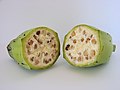 Fruits of wild-type bananas have many large, hard seeds.


Related pages[change | change source]
References[change | change source]
- ↑ "Tracing antiquity of banana cultivation in Papua New Guinea". The Australia & Pacific Science Foundation. Archived from the original on 2007-08-29. Retrieved 2009-07-17.
- ↑ "agroforestry.net" (PDF). Archived (PDF) from the original on 2014-02-28. Retrieved 2009-07-17.
- ↑ 3.0 3.1 3.2 "Uses of Musa" (PDF). UNCTAD. 1996. Archived from the original (PDF) on 2009-02-20. Retrieved 2009-08-05.
- ↑ Yes, we have more bananas Archived 2009-05-31 at the Wayback Machine published in the Royal Horticultural Society Journals, May 2002
- ↑ 5.0 5.1 "Banana from Fruits of Warm Climates by Julia Morton". Hort.purdue.edu. Archived from the original on 2009-04-15. Retrieved 2009-04-16.
- ↑ See Greenearth, Inc., Banana Plant Growing Info Archived 2008-12-30 at the Wayback Machine. Retrieved 2008.12.20.
- ↑ Valmayor, Ramón V.; Jamaluddin, S.H.; Silayoi, B.; Kusumo, S.; Danh, L.D.; Pascua, O.C. & Espino, R.R.C. (2000). Banana cultivar names and synonyms in Southeast Asia (PDF). Los Baños, Philippines: International Network for Improvement of Banana and Plantain – Asia and the Pacific Office. ISBN 978-971-91751-2-4. Archived from the original (PDF) on April 10, 2011. Retrieved February 22, 2016.
- ↑ "Nutrition Facts for raw banana, one NLEA serving, 126 g". Nutritiondata.com. Archived from the original on February 20, 2016. Retrieved February 22, 2016.
- ↑ "Fascinating Comparison Photos That Show All It Takes is a Change in Perspective". Archived from the original on 2023-03-01. Retrieved 2023-03-01.
- ↑ "FAOSTAT: ProdSTAT: Crops". Food and Agriculture Organization. 2005. Archived from the original on 24 May 2012. Retrieved 9 December 2006.
{{cite web}}: CS1 maint: bot: original URL status unknown (link) - ↑ 11.0 11.1 11.2 "Banana Exports from Latin America and the Caribbean: The Market, the Evolving Policy Framework, and Development Options" (PDF). FAO. 1998. Archived from the original (PDF) on 2010-12-26. Retrieved 2010-06-03.
- ↑ "Banana production 2003-2006". unctad. Archived from the original on 2009-08-20. Retrieved 2009-08-05.
- ↑ "Banana exports 2003-2006". unctad. Archived from the original on 2009-08-20. Retrieved 2009-08-05.
- ↑ ""The Informall Database: Communicating about Food Allergies - General Information for Banana"". Archived from the original on 2018-03-08. Retrieved 2007-04-29.
- ↑ "Traditional Crafts of Japan - Kijoka Banana Fiber Cloth". Association for the Promotion of Traditional Craft Industries. Archived from the original on 2002-02-09. Retrieved 11 December 2006.
Other websites[change | change source]

 Media related to Bananas at Wikimedia Commons
- "bananas". ssrichardmontgomery.com. Retrieved 3 June 2010.
- "Banana: Beneficial for Human". healthmad.com. Retrieved 3 June 2010.
