


Munich


.svg)


Munich (/ˈmjuːnɪk/ MEW-nik; German: München [ˈmʏnçn̩] ( listen); Bavarian: Minga [ˈmɪŋ(ː)ɐ] (listen)) is the third biggest city of Germany (after Berlin and Hamburg), and the capital of Bavaria. It has a population of around 1,500,000. The metropolitan area of Munich includes the city itself, and all the suburbs around it, and has about 3 million people in it; whereas the metropolitan region has 6.2 million people (as of 2022). It is one of the most important centres of the economy in Germany. It has an oceanic climate (Cfb in the Köppen climate classification).
People[change | change source]
The official population of Munich city proper at 310.43 km2 was 1,368,840 people with their main home there on 31st January 2009. Around 176,000 inhabitants with second homes also live inside the city limits but they are not calculated in this official census. According to some estimates that population counts around 200,000 people. The fast growing Munich urban area has 2,667,000 inhabitants (2008 estimate). Munich city with all suburbs - 12,000 km2 had 4,700,000 inhabitants. The Munich metropolitan region that covers 27,700 km2 and includes Augsburg, Ingolstadt, Landshut, Rosenheim and Landsberg has around 6,000,000 inhabitants. Munich is the 12th largest city in EU by population within the city limits and the 14th largest urban area in Europe. Its metropolitan area ranks among the largest metro areas in Europe. As of December 2008, 47.3% of Munich's residents belonged to no religious group, 38.3% are Roman Catholic, 14.0% are Lutheran Protestants and 0.3% are Jewish.[4] There is also a small Old Catholic parish and an Episcopal Church.
History[change | change source]
- 1158: The settlement was founded as Munichen by Henry the Lion.
- 1255: the Duchy of Bavaria was split in two. Munich the dukes of Upper Bavaria lived in Munich.
- 1806: Munich became the capital of the Kingdom of Bavaria.
- 1923: Beer Hall Putsch of the Nazis
- 1939-45: 45% of the city was destroyed in World War II.
- 1972: 1972 Summer Olympics
- 1980: Oktoberfest bombing
- 2016: 2016 Munich shooting
Economy[change | change source]
Munich has the strongest economy of any German city.[5] They have the lowest unemployment rate (5.6%) of any German city with more than a million people.[6][7]
Munich is the largest publishing city in Europe.[8] It is home to the Süddeutsche Zeitung, one of Germany's largest daily newspapers. Munich is also home to Germany's largest public broadcasting network, ARD, and its largest commercial network, Pro7-Sat1 Media AG. The headquarters of the German branch of Random House, the world's largest publishing house, is in Munich.
The Bavaria Film Studios are in the suburb of Grünwald. They are one of Europe's biggest and most famous movie production studios.[9]
Lufthansa has opened a second hub at Munich's Franz Josef Strauss International Airport. It is the second-largest airport in Germany, after Frankfurt International Airport.
Sights and attractions[change | change source]
- English Garden (Englischer Garten)
- Deutsches Museum (Science Museum)
- Oktoberfest
- Frauenkirche (Cathedral of Our Lady)
- Olympiaturm (Olympic Tower, a radio and TV broadcasting station)
- Bavaria statue
-
 Frauenkirche and Town Hall
 -
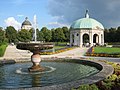 Hofgarten
 -
 Monopteros
 -
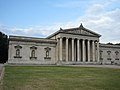 Glyptothek


Transportations[change | change source]
Airport[change | change source]
Munich Airport - Franz Joseph Strauss (IATA: MUC, ICAO: EDDM)
Public transportation[change | change source]

Munich has one of the most comprehensive systems in the world. There are subways, suburban trains, trams and buses.
Sports[change | change source]
Munich is the most successful city in Bundesliga history. FC Bayern Munich have won 20 national championship along with 13 DFB Cups, 5 UEFA Champions League/European Championship, 1 UEFA Cup and 1 UEFA Cup Winners Cup for 39 trophies.
Munich hosted the 1972 Summer Olympics. They were one of the host cities for the 2006 Football World Cup. Munich bid to host the 2018 Winter Olympic Games but lost to Pyeongchang.[10] In September 2011 the DOSB President Thomas Bach said that Munich would bid again for the Winter Olympics in the future.[11]
Sports clubs[change | change source]
- Bayern Munich
- TSV 1860 Munich
- SpVgg Unterhaching – not really a club from Munich as Unterhaching is a rural town of its own
- Munich Irish Rovers FC
- EHC Munich – local professional hockey club
Colleges and universities[change | change source]
Munich's universities are known for their high ranking in Germany.
- Ludwig-Maximilians-Universität München
- Technical University of Munich
- Munich University of Applied Sciences
Sister cities[change | change source]
 Bordeaux (France), since 1964
 Cincinnati (US), since 1989
 Edinburgh (Scotland), since 1954
 Harare (Zimbabwe), since 1996
 Kyiv (Ukraine), since 1989
 Sapporo (Japan), since 1972
 Verona (Italy), since 1960


Beers[change | change source]
References[change | change source]
- ↑ Liste der Oberbürgermeister in den kreisfreien Städten Archived 30 June 2021 at the Wayback Machine, accessed 18 July 2021.
- ↑ "Daten und Fakten aus der Metropolregion München" [Data and facts about the Munich Metropolitan Region]. Europäische Metropolregion München e.V. Archived from the original on 20 June 2019. Retrieved 20 June 2019.
- ↑ Genesis Online-Datenbank des Bayerischen Landesamtes für Statistik Tabelle 12411-003r Fortschreibung des Bevölkerungsstandes: Gemeinden, Stichtag (Einwohnerzahlen auf Grundlage des Zensus 2011)
- ↑ "Archived copy" (PDF). Archived from the original (PDF) on 25 March 2009. Retrieved 20 July 2009.
{{cite web}}: CS1 maint: archived copy as title (link) - ↑ [1] Archived 2012-06-19 at the Wayback Machine Study conducted by INSM (New Social Market Economy Initiative) and WirtschaftsWoche magazine
- ↑ [2] Archived 2008-02-20 at the Wayback Machine Bundesagentur für Arbeit (Federal agency for work)
- ↑ Artikel empfehlen (27 September 2010). "Endlich amtlich: Köln ist Millionenstadt". Koeln.de. Archived from the original on 1 October 2011. Retrieved 15 September 2011.
- ↑ "Munich Literature House: About Us". Archived from the original on 4 April 2003. Retrieved 17 February 2008.
- ↑ "Bavaria Film GmbH". Archived from the original on 29 May 2012. Retrieved 17 February 2008.
- ↑ "Olympia 2018 in Südkorea, München chancenlos". Die Welt (in German). 6 July 2011. Archived from the original on 9 July 2011. Retrieved 6 July 2011.
- ↑ "GamesBids.com - Munich to Bid Once Again". Archived from the original on 19 May 2012. Retrieved 9 July 2012.
Other websites[change | change source]
- stadt.muenchen.de/rathaus – German page
- Munich travel guide

.svg)

| International | |
|---|---|
| National | |
| Geographic | |
| Academics | |
| Other | |
