


Life
| Life | |
|---|---|

| |
| Stegosaurus in museum | |
Scientific classification 
| |
| Domains and Supergroups | |
|
Life on Earth: |
Life is a concept in biology. It is about what separates a living thing from dead matter.
Most life on Earth is powered by solar energy: the only known exceptions are the chemosynthetic bacteria living around the hydrothermal vents on the ocean floor. All life on Earth is based on the chemistry of carbon compounds, involving long-chain molecules such as proteins and nucleic acid. With water, which all life needs, the long molecules are wrapped inside membranes as cells. This may or may not be true of all possible forms of life in the Universe: it is true of all life on Earth today.
Summary[change | change source]
Living things, or organisms, can be explained as open systems. They are always changing, because they exchange materials and information with their environment. They undergo metabolism, maintain homeostasis, possess a capacity to grow, respond to stimuli and reproduce.
Through natural selection, they adapt to their environment in successive generations. More complex living organisms can communicate by various means.[2][3] Many life forms can be found on Earth. The properties common to these organisms—plants, animals, fungi, protists, archaea, and bacteria—are a carbon and water-based cellular form with complex organization and heritable genetic information.
The systems that make up life have many levels of organization. From smallest to biggest, they are: molecule, cell, tissue (group of cells with a common purpose), organ (part of the body with a purpose), organ system (group of organs that work together), organism, population (group of organisms of the same species), community (all of the organisms that interact in an area), ecosystem (all of the organisms in an area and the non-living surroundings), and biosphere (all parts of the Earth that have life).[4]: 4–5
At present, the Earth is the only planet humans have detailed information about. The question of whether life exists elsewhere in the Universe is open. There have been a number of claims of life elsewhere in the Universe. None of these have been confirmed so far. The best evidence of life outside of Earth is are nucleic acids that have been found in certain types of meteorites.[5]
Definitions[change | change source]
One explanation of life is called the cell theory. The cell theory has three basic points: all living things are made up of cells. The cell is the smallest living thing that can do all the things needed for life. All cells must come from pre-existing cells.
Something is often said to be alive if it:
- grows,
- takes in food, uses the food for energy, and passes waste products (see metabolism),
- moves: it must either move itself, or have movement inside itself,
- reproduces, either sexually (with another living thing) or asexually, by creating copies of itself,
- reacts to its surroundings,
- functions
However, not all living things fit every point on this list.
- Mules cannot reproduce, and neither can worker ants.
- Viruses and spores are not actively alive (metabolising) until the conditions are right.
They do, however, fit the biochemical definitions: they are made of the same kind of chemicals.
The thermodynamic definition of life is any system which can keep its entropy levels below maximum (usually through adaptation and mutations).
A modern approach[change | change source]
A modern definition was given by Humberto Maturana and Francisco Varela in 1980,[6] to which they gave the name autopoiesis:
- The production of their own components
- The correct assembly of these components
- Continuous repair and maintenance of their own existence.
Roth commented that "In short, organisms are self-reproducing and self-maintaining, or 'autopoietic', systems".[7] This approach makes use of molecular biology ideas and systems science ideas.
What life needs[change | change source]
Chemistry[change | change source]
Life on Earth is made from organic compounds—molecules that contain carbon. Four types of long-chain molecules (macromolecules) are important: carbohydrates, lipids, proteins, and nucleic acids.
- Simple carbohydrates (sugars) are used for energy, or as a building block. Complex carbohydrates, like starch and cellulose, can keep energy for a long time. They are also used to make a strong structure, like a plant stem.
- Lipids can be insulation to keep a living thing warm, such as fat on a penguin, or to stop water from passing in or out, such as waterproof feathers. Two layers of phospholid (a kind of lipid) make up all cell membranes. Some kinds of lipids are hormones, which send messages from one cell to another.
- Proteins, long chains of amino acids, have many purposes. They fold into complex shapes because their amino acids interact. Proteins are involved in many chemical reactions, to make them go faster.
- Nucleic acids, including DNA and RNA, are long chains of nucleotides. There are only four kinds of nucleotides in each chain, but they are the instructions for life, like a language. Each three nucleotides tell the cell to make one amino acid. One part of a nucleic acid is the code for one protein molecule.[4]: 34–48
Almost all living things need the chemical elements carbon, hydrogen, oxygen, nitrogen, sulfur, and phosphorus, to build these macromolecules.[8] Living things also need small amounts of other elements, called trace elements.[4]: 18–19 Water is a very important part of all living things. For example, humans are about two-thirds water. Water is a solvent that lets molecules mix and react with other molecules.[9]
Energy sources[change | change source]
All living things need energy to survive, move, grow, and reproduce. Some can get energy from the environment without help from other living things: these are called producers, or autotrophs. Plants, algae, and some bacteria, a group of producers called photoautotrophs, use the sun's light for energy. When producers use light to make and store organic compounds, this is called photosynthesis.[4]: 92–93 Some other producers, called chemoautotrophs, get energy from chemicals that come out of the ocean floor in hydrothermal vents.[4]: 292 Other living things get their energy from organic compounds: these are called consumers, or heterotrophs. Animals, fungi, most bacteria, and most protists are consumers. Consumers can eat other living things or dead material.[4]: 92–93
Both producers and consumers need to break down organic compounds to free energy. The best way to do this is aerobic respiration, which frees the most energy, but living things can only do aerobic respiration if they have oxygen (O2). They can also break down these compounds without oxygen, using anaerobic respiration or fermentation.[4]: 108–120
Cells[change | change source]
All living things have cells. Every cell has a cell membrane on the outside, and a jelly-like material that fills the inside, called cytoplasm. The membrane is important because it separates the chemicals inside and outside. Some molecules can pass through the membrane, but others cannot. Living cells have genes, made of DNA. Genes say to the cell what to do, like a language. One DNA molecule, with many genes, is called a chromosome. Cells can copy themselves to make two new cells.
There are two main kinds of cells: prokaryotic and eukaryotic. Prokaryotic cells have only a few parts. Their DNA is the shape of a circle, inside the cytoplasm, and they have no membranes inside the cell. Eukaryotic cells are more complex, and they have a cell nucleus. The DNA is inside the nucleus, and a membrane is around the nucleus. Eukaryotic cells also have other parts, called organelles. Some of these other organelles also have membranes.[10]
Types of life[change | change source]
Taxonomy is how lifeforms are put into groups. The smaller groups are more closely related, but the larger classes are more distantly related. The levels, or ranks, of taxonomy are domain, kingdom, phylum, class, order, family, genus, and species. There are many ideas for the meaning of species.[11] One idea, called the biological species concept, is as follows. A species is a group of living things that can mate with each other, and whose children can make their own children.[4]: 272
Taxonomy aims to group together living things with a common ancestor. This can now be done by comparing their DNA. Originally, it was done by comparing their anatomy.[11][12]
The three domains of life are Bacteria, Archaea, and Eukarya.[13]: 6–7 Bacteria and archaea are prokaryotic and have only one cell. Bacteria range in size from 0.15 cubic micrometres (Mycoplasma) to 200,000,000 cubic micrometres (Thiomargarita namibiensis). Bacteria have shapes which are useful in classification, such as round, long and thin, and spiral. Some bacteria cause diseases. Bacteria in our intestines are part of our gut flora. They break down some of our food. Both bacteria and archaea may live where larger forms of life cannot. Bacteria have a molecule called peptidoglycan in their cell wall, but archaea do not. Archaea have a molecule called isoprene in their cell membrane, but bacteria do not.[13]: 496–516
Eukarya are living things with eukaryotic cells, and they can have one cell or many cells. Most eukaryotes use sexual reproduction to make new copies of themselves. In sexual reproduction, two sex cells, one from each parent, join to make a new living thing.[4]: 138–139
Plants are eukaryotes that use the Sun's light for energy. They include algae, which live in water, and land plants. All land plants have two forms during their life cycle, called alternation of generations. One form is diploid, where the cells have two copies of their chromosomes, and the other form is haploid, where the cells have one copy of their chromosomes. In land plants, both diploid and haploid forms have many cells. Two kinds of land plants are vascular plants and bryophytes. Vascular plants have long tissues that stretch from end to end of the plant. These tissues carry water and food. Most plants have roots and leaves.[13]: 546–577
Animals are eukaryotes with many cells, which have no rigid cell walls. All animals are consumers: they survive by eating other organic material. Almost all animals have neurons, a signalling system. They usually have muscles, which make the body move. Many animals have a head and legs. Most animals are either male or female. They need a mate of the opposite sex to make offspring. Sex cells from the male and female can meet inside or outside the body.[13]: 601–617
Fungi are eukaryotes which may have one cell, like yeasts, or many cells, like mushrooms. They are saprophytes. Fungi break down living or dead material, so they are decomposers. Only fungi, and a few bacteria, can break down lignin and cellulose, two parts of wood. Some fungi are mycorrhiza. They live under ground and give nutrients to plants, like nitrogen and phosphorus.[13]: 579 Eukaryotes that are not plants, animals, or fungi are called protists. Most protists live in water.[13]: 519–520
Evolution[change | change source]
Over thousands or millions of years, living things can change, through the process of evolution. One kind of evolution is when a species changes over time, such as giraffes growing longer necks. Most of the time, the species becomes better suited to its environment, a process called adaptation. Evolution can also cause one group of living things to split into two groups. This is called speciation if it makes a new species. An example is mockingbirds on the Galapagos Islands—one species of mockingbird lives on each island, but all the species split from a shared ancestor species. Groups that are bigger than species can also split from a shared ancestor—for example, reptiles and mammals. A group of living things and their shared ancestor is called a clade.[14]
Living things can evolve to be quite different from their ancestors. As a result, parts of the body can also change. The same bone structure became the hands of humans, the hooves of horses, and the wings of birds. Different body parts that evolved from the same thing are called homologous.[14]
Extinction is when all members of a species die. About 99.9% of all species that have ever lived are extinct. Extinction can happen at any time, but it is more common in certain time periods called extinction events. The most recent was 65 million years ago, when the dinosaurs[a] went extinct.[15]
Origin of life[change | change source]
By comparing fossils and DNA, we know that all life on Earth today had a shared ancestor, called the last universal common ancestor (LUCA). Other living things may have been alive at the same time as the LUCA, but they died out. A study from 2018 suggests that the LUCA is about 4.5 billion (4,500,000,000) years old, nearly as old as the Earth.[16] The oldest fossil evidence of life is about 3.5 billion years old.[17]
How did non-living material become alive? This is a difficult question. The first step must have been the creation of organic compounds. In 1953, the Miller–Urey experiment made inorganic compounds into organic compounds, such as amino acids, using heat and energy.[18]
Life needs a source of energy for chemical reactions. On the early Earth, the atmosphere did not have oxygen. Oxidation using the Krebs cycle, which is common today, was not possible. The Krebs cycle may have acted backwards, doing reduction instead of oxidation, and the cycle may have made larger molecules. To make life, molecules needed to make copies of themselves. DNA and RNA make copies of themselves, but only if there is a catalyst—a compound which speeds up the chemical reaction. One guess is that RNA itself served as a catalyst. At some time, the molecules were surrounded by membranes, which made cells.[18]
Gallery of images of life[change | change source]
-

-

-
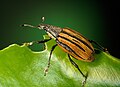 An adult citrus root weevil is an example of an insect.
 -
 Salmonella typhimurium is an example of bacteria.
 -
 Chromalveolates are a group of protista.
 -
 Amanita muscaria (Fly agaric) is an example of fungi.
 -

-

-
 People are an example of mammals.


Related pages[change | change source]
Notes[change | change source]
References[change | change source]
- ↑ International Committee on Taxonomy of Viruses Executive Committee (May 2020). "The New Scope of Virus Taxonomy: Partitioning the Virosphere Into 15 Hierarchical Ranks". Nature Microbiology. 5 (5): 668–674. doi:10.1038/s41564-020-0709-x. PMC 7186216. PMID 32341570.
- ↑ Koshland, Jr., Daniel E. (22 March 2002). "The seven pillars of life". Science. 295 (5563): 2215–2216. doi:10.1126/science.1068489. PMID 11910092. S2CID 153363768. Archived from the original on 28 February 2009. Retrieved 25 May 2009.
- ↑ "organism". Chambers 21st Century Dictionary (online ed.). 1999.
- ↑ 4.0 4.1 4.2 4.3 4.4 4.5 4.6 4.7 4.8 Starr, Cecie (2006). Biology : concepts and applications. Christine A. Evers, Lisa Starr (6th ed.). Belmont, CA: Thomson, Brooks/Cole. ISBN 0-534-46223-5. OCLC 57966041.
- ↑ Martins, Zita (2008). "Extraterrestrial nucleobases in the Murchison meteorite" (PDF). Earth and Planetary Science Letters. 270 (1–2). Oliver Botta, Marilyn L. Fogel, Mark A. Sephton, Daniel P. Glavin, Jonathan S. Watson, Jason P. Dworkin, Alan W. Schwartz, Pascale Ehrenfreund: 130–136. arXiv:0806.2286. Bibcode:2008E&PSL.270..130M. doi:10.1016/j.epsl.2008.03.026. S2CID 14309508. Archived from the original (PDF) on 2011-08-10. Retrieved 2015-03-10.
- ↑ Maturana H. & Varela F. 1980. Autopoiesis and cognition: the realization of the living. Boston: Reidel.
- ↑ Roth G. 2013. The long evolution of brains and minds. Heidelberg: Springer. p41, 48
- ↑ Hotz, Robert Lee (3 December 2010). "New link in chain of life". Wall Street Journal. Dow Jones & Company, Inc. Archived from the original on 17 August 2017.
Until now, however, they were all thought to share the same biochemistry, based on the Big Six, to build proteins, fats and DNA.
- ↑ "NASA - Water: The Molecule of Life An Interview with Philip Ball". www.nasa.gov. 2007-11-30. Archived from the original on 2021-03-14. Retrieved 2021-03-29.
- ↑ "What Is a Cell?". Scitable by Nature Education. 2014. Archived from the original on 2020-11-03. Retrieved 2021-03-28.
- ↑ 11.0 11.1 Wilcox, Christie (24 June 2019). "What's in a name? Taxonomy problems vex biologists". Quanta Magazine. Archived from the original on 2023-02-16. Retrieved 2021-03-29.
- ↑ Luketa, Stefan (2012). "New views on the megaclassification of life". Protistology. 7 (4): 218–237. ISSN 1680-0826.
- ↑ 13.0 13.1 13.2 13.3 13.4 13.5 Freeman, Scott (2011). Biological Science (4th ed.). San Francisco, CA: Pearson Education, Inc. ISBN 978-0-321-59796-0. OCLC 472790415.
- ↑ 14.0 14.1 Mayr, Ernst. 2001. What evolution is. Weidenfeld & Nicolson, London. ISBN 0-465-04426-3
- ↑ Newman, M. E. J.; Palmer, R. G. (1999-08-06). "Models of Extinction: A Review". arXiv:adap-org/9908002. Bibcode:1999adap.org..8002N.
{{cite journal}}: Cite journal requires|journal=(help) - ↑ "A timescale for the origin and evolution of all of life on Earth". phys.org. University of Bristol. Archived from the original on 2021-03-03. Retrieved 2021-04-02.
- ↑ "Oldest fossils ever found show life on Earth began before 3.5 billion years ago". news.wisc.edu. Archived from the original on 2021-05-31. Retrieved 2021-05-01.
- ↑ 18.0 18.1 Trefil, James; Morowitz, Harold J.; Smith, Eric (2017-02-06). "The Origin of Life". American Scientist. Archived from the original on 2021-04-01. Retrieved 2021-04-02.


