List of counties in Alabama
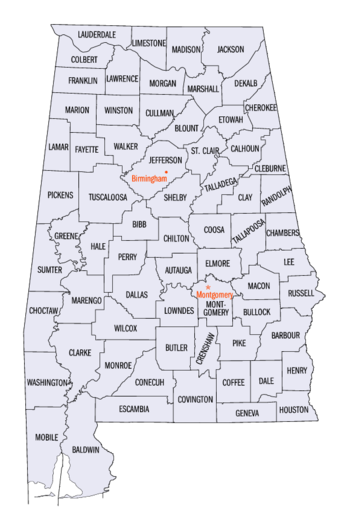
The U.S. state of Alabama has sixty-seven counties. The oldest is Washington County (created June 4, 1800) and the youngest is Houston County (created February 9, 1903).
Alabama was claimed by Spain, as Spanish Florida, and by England, as the Province of Carolina. The first permanent colony was made by the French on the banks of the Mobile River in 1702.
After the American Revolutionary War, West Florida south of the 31st parallel became a part of Spain while most of the rest was put in the Mississippi Territory. The territorial assembly established some of the earliest county divisions which have survived to the present. In 1817 the western part of the territory became the State of Mississippi and the remainder the Alabama Territory. The Alabama territorial legislature made some more counties.
Alabama became the 22nd state of the United States in 1819. The Alabama state legislature made more counties from former Indian lands as the Indian Removal Act took effect and settlers populated different areas of Alabama.
In 1820, Alabama had 29 counties. By 1830 there were 36, with Indians still occupying land in northeast and far western Alabama. By 1840, 49 counties had been created; 52 by 1850; 65 by 1870; and the present 67 counties by 1903.[1]
According to 2020 U.S. Census data, the average population of Alabama's sixty-seven counties was 74,989, while Jefferson County had the most people (674,721), and Greene County (7,730) had the least. The average land area is 756 sq mi (1,958 km2). The largest county is Baldwin (1,590 sq mi or 4,118 km2), and the smallest is Etowah (535 sq mi or 1,386 km2).
The Federal Information Processing Standard (FIPS) code, which is used by the United States government to uniquely identify counties, is provided with each entry. (In this system, St. Clair County is alphabetized ahead of Shelby County.) The FIPS code links in the table point to U.S. Census "quick facts" pages for each county.
Counties[change | change source]
| County |
FIPS code[2] | County seat[3] | License # [4] |
Created[3] | Formed from[5] | Meaning of name[1][6] | Density |
Population (2020)[7] |
Land Area[3] | Map |
|---|---|---|---|---|---|---|---|---|---|---|
| Autauga County | 001 | Prattville | 4 | 1818 | Montgomery County | The Autauga or Atagi people, Native Americans who were a sub-group of the Alibamu | 98.9 | 58,805 | 594.44 sq mi (1,540 km2) |

|
| Baldwin County | 003 | Bay Minette | 5 | 1809 | Washington County and West Florida | Abraham Baldwin (1754–1807), U.S. legislator from Georgia | 145.8 | 231,767 | 1,589.78 sq mi (4,118 km2) |

|
| Barbour County | 005 | Clayton | 6 | 1832 | Pike County | James Barbour (1775–1842), Governor of Virginia and U.S. Senator | 28.5 | 25,223 | 884.88 sq mi (2,292 km2) |

|
| Bibb County | 007 | Centreville | 7 | 1818 | Montgomery County (as Cahawba County) | William Wyatt Bibb (1781–1820), 1st Governor of Alabama | 35.8 | 22,293 | 622.58 sq mi (1,612 km2) |

|
| Blount County | 009 | Oneonta | 8 | 1818 | Montgomery County and Creek territories | Willie Blount (1768–1835), Governor of Tennessee | 91.7 | 59,134 | 644.78 sq mi (1,670 km2) |

|
| Bullock County | 011 | Union Springs | 9 | 1866 | Barbour, Macon, Montgomery, and Pike counties | Edward Bullock (1822–1861), colonel in the Confederate States Army | 16.6 | 10,357 | 622.80 sq mi (1,613 km2) |

|
| Butler County | 013 | Greenville | 10 | 1819 | Conecuh and Monroe counties | William Butler (?–1818), captain in Creek War | 24.5 | 19,051 | 776.83 sq mi (2,012 km2) |

|
| Calhoun County | 015 | Anniston | 11 | 1832 | St. Clair County (as Benton County) | John C. Calhoun (1782–1850), 7th U.S. Vice President | 192.2 | 116,441 | 605.87 sq mi (1,569 km2) |

|
| Chambers County | 017 | LaFayette | 12 | 1832 | Montgomery County | Henry H. Chambers (1790–1826), U.S. Senator | 58.3 | 34,772 | 596.53 sq mi (1,545 km2) |

|
| Cherokee County | 019 | Centre | 13 | 1836 | Cherokee territory | Cherokee people, whose lands included Northeast Alabama | 45.1 | 24,971 | 553.70 sq mi (1,434 km2) |

|
| Chilton County | 021 | Clanton | 14 | 1868 | Autauga, Bibb, Perry, and Shelby counties (as Baker County) | William Parish Chilton (1810–1871), Alabama Supreme Court Justice and Confederate congressman | 65.0 | 45,014 | 692.85 sq mi (1,794 km2) |

|
| Choctaw County | 023 | Butler | 15 | 1847 | Sumter and Washington counties | Choctaw people, whose lands included Alabama | 13.9 | 12,665 | 913.50 sq mi (2,366 km2) |

|
| Clarke County | 025 | Grove Hill | 16 | 1812 | Washington County | John Clarke (1766–1832), general from Georgia | 18.6 | 23,087 | 1,238.46 sq mi (3,208 km2) |

|
| Clay County | 027 | Ashland | 17 | 1866 | Randolph and Talladega counties | Henry Clay (1777–1852), U.S. legislator from Kentucky | 23.6 | 14,236 | 603.96 sq mi (1,564 km2) |

|
| Cleburne County | 029 | Heflin | 18 | 1866 | Calhoun, Randolph, and Talladega counties | Patrick Cleburne (1828–1864), Major General in Confederate States Army | 26.9 | 15,056 | 560.10 sq mi (1,451 km2) |

|
| Coffee County | 031 | Elba and Enterprise[8] | 19 | 1841 | Dale County | John Coffee (1772–1833), military leader in War of 1812 and Creek War | 78.7 | 53,465 | 678.97 sq mi (1,759 km2) |

|
| Colbert County | 033 | Tuscumbia | 20 | 1867 | Franklin County | George Colbert (1764–1839) and Levi Colbert (1759–1834), Chickasaw chiefs | 96.6 | 57,227 | 592.62 sq mi (1,535 km2) |

|
| Conecuh County | 035 | Evergreen | 21 | 1818 | Monroe County | The Conecuh River, which flows through the county | 13.6 | 11,597 | 850.16 sq mi (2,202 km2) |

|
| Coosa County | 037 | Rockford | 22 | 1832 | Montgomery County | The Coosa River, which flows through the county, and is itself named after a Native American village | 16.0 | 10,387 | 650.93 sq mi (1,686 km2) |

|
| Covington County | 039 | Andalusia | 23 | 1821 | Henry County | Leonard Covington (1768–1813), Brigadier General in War of 1812 and U.S. Congressman | 36.5 | 37,570 | 1,030.46 sq mi (2,669 km2) |

|
| Crenshaw County | 041 | Luverne | 24 | 1866 | Butler, Coffee, Covington, Lowndes, and Pike Counties | Anderson Crenshaw (1783–1847), Alabama Supreme Court justice and early settler | 21.7 | 13,194 | 608.84 sq mi (1,577 km2) |

|
| Cullman County | 043 | Cullman | 25 | 1877 | Blount, Morgan, and Winston counties | Colonel John G. Cullmann (1823–1895), founder of county seat | 119.6 | 87,866 | 734.84 sq mi (1,903 km2) |

|
| Dale County | 045 | Ozark | 26 | 1824 | Covington and Henry counties | Samuel Dale (1772–1841), Brigadier General and state legislator | 87.9 | 49,326 | 561.15 sq mi (1,453 km2) |

|
| Dallas County | 047 | Selma | 27 | 1818 | Monroe and Montgomery counties | Alexander James Dallas (1759–1817), U.S. Secretary of Treasury | 39.3 | 38,462 | 978.69 sq mi (2,535 km2) |

|
| DeKalb County | 049 | Fort Payne | 28 | 1836 | Cherokee territory | Johann de Kalb (1721–1780), major general in American Revolutionary War | 91.1 | 71,608 | 777.09 sq mi (2,013 km2) |

|
| Elmore County | 051 | Wetumpka | 29 | 1866 | Autauga, Coosa, Montgomery, and Tallapoosa counties | John Archer Elmore (1762–1834), Revolutionary War veteran | 142.2 | 87,977 | 618.48 sq mi (1,602 km2) |

|
| Escambia County | 053 | Brewton | 30 | 1868 | Baldwin and Conecuh counties | Escambia Creek, a tributary of the Conecuh River | 38.9 | 36,757 | 945.08 sq mi (2,448 km2) |

|
| Etowah County | 055 | Gadsden | 31 | 1866 | Blount, Calhoun, Cherokee, DeKalb, Marshall, and St. Clair counties (as Baine County) | Etowah Indian Mounds | 193.3 | 103,436 | 534.99 sq mi (1,386 km2) |

|
| Fayette County | 057 | Fayette | 32 | 1824 | Marion, Pickens, Tuscaloosa, and Walker counties | Gilbert du Motier, marquis de La Fayette (1757–1834), Revolutionary War commander | 26.0 | 16,321 | 627.66 sq mi (1,626 km2) |

|
| Franklin County | 059 | Russellville | 33 | 1818 | Cherokee territory | Benjamin Franklin (1706–1790), politician, diplomat, inventor, and publisher | 50.7 | 32,113 | 633.82 sq mi (1,642 km2) |

|
| Geneva County | 061 | Geneva | 34 | 1868 | Coffee, Dale, and Henry counties | Named after Geneva, New York, the origin of several early settlers | 46.4 | 26,659 | 574.41 sq mi (1,488 km2) |

|
| Greene County | 063 | Eutaw | 35 | 1819 | Marengo and Tuscaloosa counties | Nathanael Greene (1742–1786), Revolutionary War general | 11.9 | 7,730 | 647.11 sq mi (1,676 km2) |

|
| Hale County | 065 | Greensboro | 36 | 1867 | Greene, Marengo, Perry, and Tuscaloosa counties | Stephen F. Hale (1816–1862), lieutenant colonel in Confederate States Army | 23.0 | 14,785 | 643.94 sq mi (1,668 km2) |

|
| Henry County | 067 | Abbeville | 37 | 1819 | Conecuh County | Patrick Henry (1736–1799), Revolutionary War patriot and Governor of Virginia | 30.5 | 17,146 | 561.75 sq mi (1,455 km2) |

|
| Houston County | 069 | Dothan | 38 | 1903 | Dale, Geneva, and Henry counties | George S. Houston (1811–1879), 24th Governor of Alabama and U.S. Congressman | 184.9 | 107,202 | 579.82 sq mi (1,502 km2) |

|
| Jackson County | 071 | Scottsboro | 39 | 1819 | Cherokee territory | Andrew Jackson (1767–1845), 7th U.S. President | 48.8 | 52,579 | 1,077.87 sq mi (2,792 km2) |

|
| Jefferson County | 073 | Birmingham | 1 | 1819 | Blount County | Thomas Jefferson (1743–1826), 3rd U.S. President | 607.2 | 674,721 | 1,111.28 sq mi (2,878 km2) |

|
| Lamar County | 075 | Vernon | 40 | 1867 | Fayette and Marion counties (as Jones County) | Lucius Q. C. Lamar (1825–1893), U.S. Supreme Court justice | 23.1 | 13,972 | 604.85 sq mi (1,567 km2) |

|
| Lauderdale County | 077 | Florence | 41 | 1818 | Cherokee and Chickasaw territories | James Lauderdale (1780–1814), Colonel in War of 1812 | 140.1 | 93,564 | 667.70 sq mi (1,729 km2) |

|
| Lawrence County | 079 | Moulton | 42 | 1818 | Cherokee territory | James Lawrence (1781–1813), naval officer in War of 1812 | 47.9 | 33,073 | 690.68 sq mi (1,789 km2) |

|
| Lee County | 081 | Opelika | 43 | 1866 | Chambers, Macon, Russell, and Tallapoosa counties | Robert E. Lee (1807–1870), Commander of the Confederate States Army | 286.8 | 174,241 | 607.54 sq mi (1,574 km2) |

|
| Limestone County | 083 | Athens | 44 | 1818 | Elk and Madison counties | Limestone Creek, named for local geological deposits | 185.0 | 103,570 | 559.94 sq mi (1,450 km2) |

|
| Lowndes County | 085 | Hayneville | 45 | 1830 | Butler, Dallas, and Montgomery counties | William Lowndes (1782–1822), U.S. Congressman from South Carolina | 14.4 | 10,311 | 715.91 sq mi (1,854 km2) |

|
| Macon County | 087 | Tuskegee | 46 | 1832 | Montgomery County | Nathaniel Macon (1758–1837), U.S. legislator from North Carolina | 32.1 | 19,532 | 608.89 sq mi (1,577 km2) |

|
| Madison County | 089 | Huntsville | 47 | 1808 | Cherokee and Chickasaw territories | James Madison (1751–1836), 4th U.S. President | 484.2 | 388,153 | 801.59 sq mi (2,076 km2) |

|
| Marengo County | 091 | Linden | 48 | 1818 | Choctaw territory | Battle of Marengo | 19.8 | 19,323 | 976.88 sq mi (2,530 km2) |

|
| Marion County | 093 | Hamilton | 49 | 1818 | Tuscaloosa County | Francis Marion (1732–1795), military leader in American Revolutionary War | 39.5 | 29,341 | 742.29 sq mi (1,923 km2) |

|
| Marshall County | 095 | Guntersville | 50 | 1836 | Blount and Jackson counties and Cherokee territory | John Marshall (1755–1835), Chief Justice of the United States 1801–1835 | 172.5 | 97,612 | 565.84 sq mi (1,466 km2) |

|
| Mobile County | 097 | Mobile | 2 | 1812 | Mobile District of West Florida after annexation into Mississippi Territory | Mobile Bay, on which county is located, and which is itself named after the Maubila tribe of Native Americans | 337.4 | 414,809 | 1,229.44 sq mi (3,184 km2) |

|
| Monroe County | 099 | Monroeville | 51 | 1815 | Creek territory | James Monroe (1758–1831), 5th U.S. President | 19.3 | 19,772 | 1,025.67 sq mi (2,656 km2) |

|
| Montgomery County | 101 | Montgomery | 3 | 1816 | Monroe County | Lemuel P. Montgomery (1786–1814), Major in Creek War | 291.9 | 228,954 | 784.25 sq mi (2,031 km2) |

|
| Morgan County | 103 | Decatur | 52 | 1818 | Cherokee territory (as Cotaco County) | Daniel Morgan (1736–1802), U.S. Congressman | 213.0 | 123,421 | 579.34 sq mi (1,500 km2) |

|
| Perry County | 105 | Marion | 53 | 1819 | Cahawba, Dallas, Marengo, and Tuscaloosa counties | Oliver Hazard Perry (1795–1819), naval officer in War of 1812 | 11.8 | 8,511 | 719.66 sq mi (1,864 km2) |

|
| Pickens County | 107 | Carrollton | 54 | 1820 | Tuscaloosa County | Andrew Pickens (1739–1817), General in the Revolutionary War | 21.7 | 19,123 | 881.41 sq mi (2,283 km2) |

|
| Pike County | 109 | Troy | 55 | 1821 | Henry and Montgomery counties | Zebulon Pike (1779–1813), explorer and officer in War of 1812 | 49.1 | 33,009 | 672.09 sq mi (1,741 km2) |

|
| Randolph County | 111 | Wedowee | 56 | 1832 | St. Clair and Shelby counties | John Randolph (1773–1833), U.S. Senator from Virginia | 37.8 | 21,967 | 580.55 sq mi (1,504 km2) |

|
| Russell County | 113 | Phenix City | 57 | 1832 | Barbour, Bullock, Lee and Macon counties | Gilbert C. Russell (1782–1861), officer in Creek War | 92.3 | 59,183 | 641.14 sq mi (1,661 km2) |

|
| St. Clair County | 115 | Ashville and Pell City | 59 | 1818 | Shelby County | Arthur St. Clair (1736–1818), President of Continental Congress | 144.2 | 91,103 | 631.90 sq mi (1,637 km2) |

|
| Shelby County | 117 | Columbiana | 58 | 1818 | Montgomery County | Isaac Shelby (1750–1826), Governor of Kentucky | 284.1 | 223,024 | 784.93 sq mi (2,033 km2) |

|
| Sumter County | 119 | Livingston | 60 | 1832 | Choctaw territory | Thomas Sumter (1734–1832), U.S. Congressman from South Carolina | 13.7 | 12,345 | 903.89 sq mi (2,341 km2) |

|
| Talladega County | 121 | Talladega | 61 | 1832 | St. Clair and Shelby counties | Talatigi, Creek Indian name for the county seat, meaning "border town" | 111.5 | 82,149 | 736.78 sq mi (1,908 km2) |

|
| Tallapoosa County | 123 | Dadeville | 62 | 1832 | Montgomery and Shelby counties | Tallapoosa River | 57.7 | 41,311 | 716.52 sq mi (1,856 km2) |

|
| Tuscaloosa County | 125 | Tuscaloosa | 63 | 1818 | Montgomery County and Choctaw territory | Iroquoian name for the Black Warrior River | 171.8 | 227,036 | 1,321.75 sq mi (3,423 km2) |

|
| Walker County | 127 | Jasper | 64 | 1823 | Blount, Jefferson, and Tuscaloosa counties | John Williams Walker (1783–1823), U.S. Senator from Alabama | 82.6 | 65,342 | 791.19 sq mi (2,049 km2) |

|
| Washington County | 129 | Chatom | 65 | 1800 | Adams and Pickering counties of Mississippi Territory | George Washington (1732–1799), 1st U.S. President | 14.2 | 15,388 | 1,080.21 sq mi (2,798 km2) |

|
| Wilcox County | 131 | Camden | 66 | 1819 | Dallas and Monroe counties | Joseph M. Wilcox (1790–1814), lieutenant in Creek War | 11.9 | 10,600 | 888.50 sq mi (2,301 km2) |

|
| Winston County | 133 | Double Springs | 67 | 1850 | Walker County (as Hancock County) | John A. Winston (1812–1871), 15th Governor of Alabama | 38.4 | 23,540 | 612.98 sq mi (1,588 km2) |

|
Former counties and county names[change | change source]
- Baine County (for David W. Baine), changed to Etowah County in 1868
- Baker County (for Alfred Baker, a local landowner), changed to Chilton County in 1874
- Benton County, first named in 1832 for Thomas Hart Benton. In 1849, Benton renounced his support for slavery, alienating him from the Democratic Party. He lost his seat in 1851, and in 1858 the name of the county was changed to Calhoun County, honoring Benton's Senate rival, John C. Calhoun, who had died soon after presiding over the momentous Compromise of 1850.
- Cahawba County, for the former capital city of Cahawba, changed to Bibb County in 1820
- Cotaco County (for Cotaco Creek), changed to Morgan County in 1821
- Elk County (for the Elk River), originally part of another Houston County (for John Houstoun), changed to Lauderdale County and Limestone County in 1818
- Hancock County (for John Hancock), changed to Winston County in 1858
- Jones County (for Josiah Jones, a local political leader), changed back to Covington County in 1868 after Jones refused the honor
- Jones County (for E. P. Jones), then Sanford County, before becoming Lamar County in 1877
- Sanford County (for H. C. Sanford), changed to Lamar County in 1877
Fictional counties of note[change | change source]
- Aurora County, the setting for several books by Deborah Wiles.
- Beechum County, the setting for the 1992 film, My Cousin Vinny.
- Greenbow County, the title character's birthplace in the 1986 Winston Groom novel Forrest Gump, which was adapted into a feature film in 1994.
- Hazzard County, the setting for the CBS TV show The Dukes of Hazzard, that ran from 1979-1985.
- Maycomb County, the setting for Harper Lee's 1960 novel To Kill a Mockingbird, which was adapted into a feature film in 1962.
- Pearl County, the setting for William March's 1943 novel Looking Glass and of several of his short stories.
References[change | change source]
- "CountyState.info Alabama". Official County Websites. Archived from the original on 2013-09-01. Retrieved 2007-09-13. - official sites
- ↑ 1.0 1.1 Foscue, Virginia O. (1989) Place Names in Alabama. Tuscaloosa, Alabama: University of Alabama Press. ISBN 0-8173-0410-X
- ↑ "EPA County FIPS Code Listing". EPA.gov. Archived from the original on October 8, 2012. Retrieved 2008-02-23.
- ↑ 3.0 3.1 3.2 National Association of Counties. "NACo County Explorer". Retrieved 2015-10-25.
- ↑ Nicholson, David. "Alabama County Codes". License Plates of North America, 1969–present. Retrieved 2009-05-25.
- ↑ Owen, Thomas McAdory; Owen, Marie Bankhead (1921). History of Alabama and Dictionary of Alabama Biography. Chicago: S.J. Clarke Publishing Company.
- ↑ "Alabama Counties". Alabama Department of Archives and History. Archived from the original on 2018-12-24. Retrieved 2009-06-01.
- ↑ U.S. Census Bureau. "QuickFacts: Alabama". Retrieved 2021-09-02.
- ↑ Coffee County, Alabama. "History of Coffee County". Archived from the original on October 27, 2011. Retrieved 2011-08-19.